Transparency note: This article contains no affiliate links, and no company paid for or reviewed it. I pay for most of the AI tools I use myself.
I spent three years and about $200 on a language app before I could hold a 30-second conversation. Then I spent two months practicing with ChatGPT and had my first real back-and-forth in Spanish. Same brain, very different result.
The difference wasn’t magic. It’s that ChatGPT will talk to you at 11pm, never judges your terrible verb tenses, and switches from tutor to conversation partner the second you ask. Apps drill you. ChatGPT actually converses.
Here’s exactly how I use ChatGPT for language learning — the four modes I switch between, the prompts you can copy, and the honest limits (there are real ones, especially around pronunciation). This won’t replace a human tutor. But it’ll get you talking a lot faster than flashcards.
Why ChatGPT works for language learning (and where it fails)
Most apps teach you to pass their quizzes. You get great at tapping the right word and stay terrified of actual conversation. ChatGPT flips that — you practice the scary part, talking, in a place where mistakes cost nothing.
But be clear-eyed about the limits. It can’t hear your accent or fix your pronunciation from text alone. It occasionally invents grammar rules that sound confident and are wrong, especially in less common languages. And it won’t correct you unless you tell it to — by default it’s too polite.
So treat it as a tireless practice partner, not an authority. Cross-check anything that feels off, and use a real speaker or a tool with audio for pronunciation. With that framing, it’s the best free practice I’ve found.
Pro tip: The free version is plenty for text practice. If you want spoken practice, ChatGPT’s voice mode helps, but it’s not a substitute for hearing native speakers.
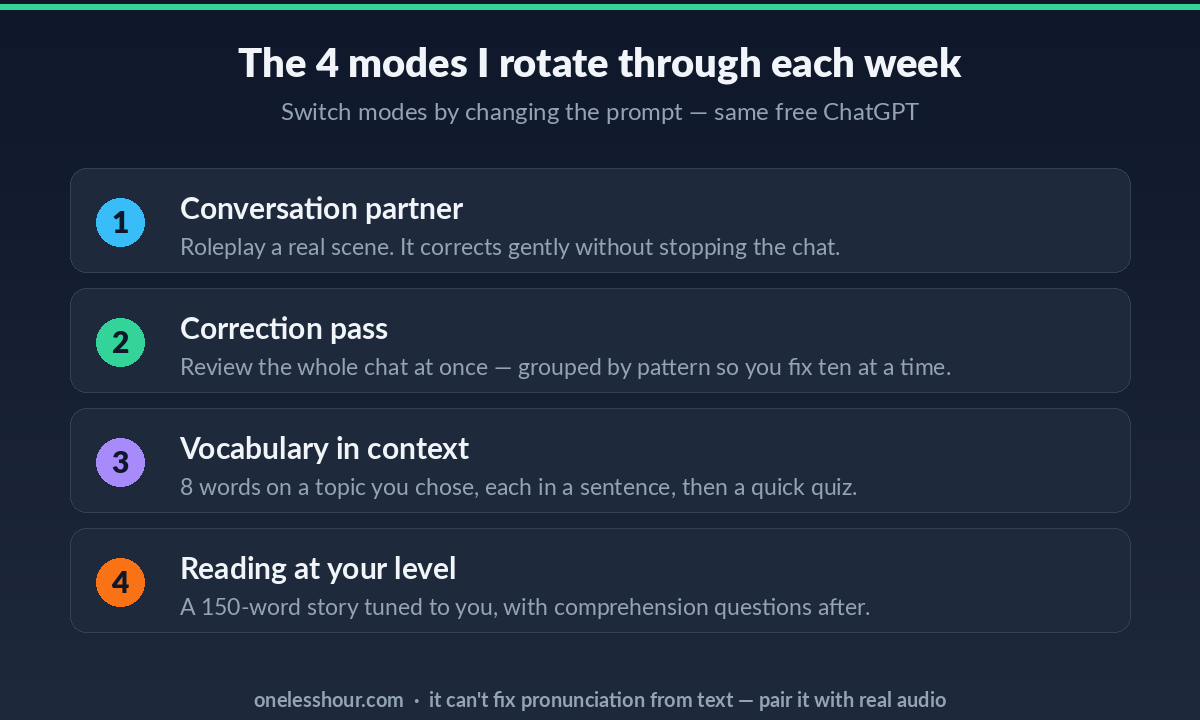
Mode 1: The conversation partner that never gets bored
This is the one that changed everything for me. Instead of studying the language, you use it — in a low-stakes chat where you can stop and ask “how do I say X?” mid-sentence.
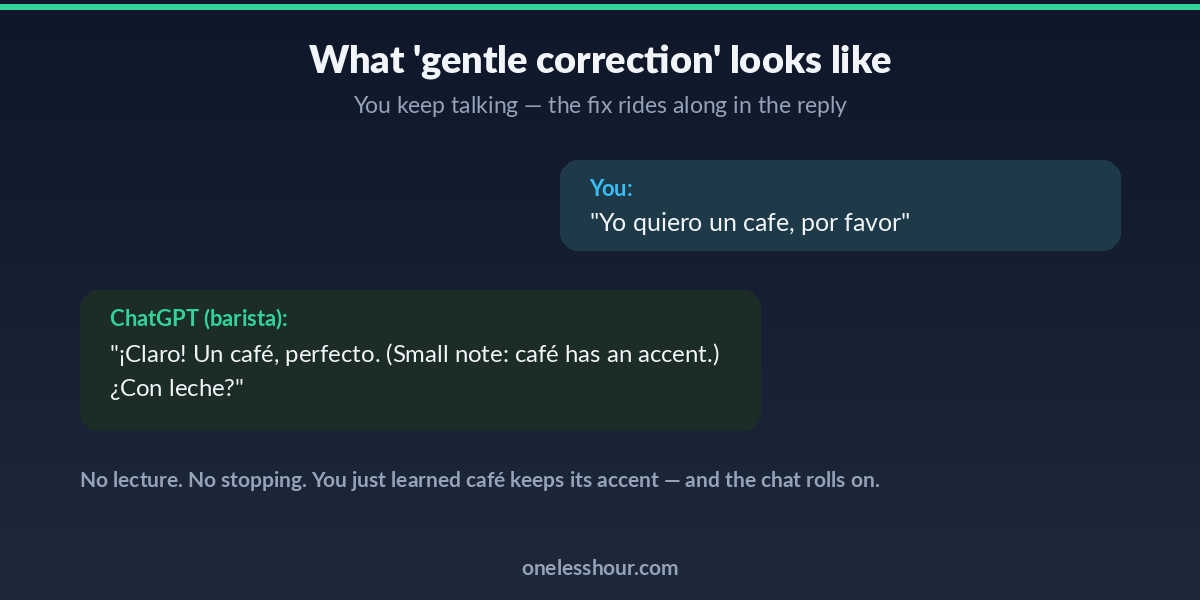
Let’s have a conversation in [language] at a beginner level. You play a barista and I’m ordering coffee. Keep your replies short and simple. If I make a mistake, don’t stop the conversation — just gently include the correct version in your reply. Start when ready.
The “don’t stop the conversation” instruction is key. You want to keep talking, not get a grammar lecture after every line. As you improve, swap “beginner” for “intermediate” and pick harder scenarios — a job interview, an argument with a landlord, whatever’s useful to you.
Try this now: Run this for five minutes on a scenario you’d actually face. Real situations stick far better than “the cat is on the table.”
Mode 2: The correction pass
After a conversation, switch modes and ask ChatGPT to review your mistakes in one batch. Getting it all at the end keeps the chat flowing but still teaches you.
Now review our whole conversation. List every mistake I made in [language], show the correction, and explain the rule in one short sentence each. Group similar mistakes together so I can see my patterns.
That “group similar mistakes” line is the gold. It’s how I found out I’d been butchering the same past-tense ending for weeks. Once you see the pattern, you fix ten future mistakes at once.
Pro tip: Keep a running note of your top three repeat mistakes. Paste it into your next practice session and ask ChatGPT to watch for them.
Mode 3: Vocabulary that actually sticks
Memorizing word lists is how you forget words. You remember vocabulary in context — in sentences about your own life. ChatGPT builds those on demand.
Teach me 8 useful [language] words for [topic, e.g. cooking]. For each one, give the word, a simple example sentence, and the English translation. Then quiz me by giving 3 fill-in-the-blank sentences using them.
The built-in quiz matters. Reading a word does little; recalling it does a lot. And because you chose the topic, the words are ones you’ll actually use, not “the pen of my aunt.”
Try this now: Pick a topic from your real week — a work meeting, a recipe, weekend plans — and learn eight words for it. Use one of them today.
Mode 4: Reading at exactly your level
Real articles are too hard when you’re starting; kids’ books are boring. ChatGPT writes stories tuned to precisely where you are.
Write a 150-word short story in [language] for an [beginner/intermediate] learner, about [topic you like]. Use common vocabulary. After the story, ask me 3 comprehension questions in [language], and wait for my answers before telling me if I’m right.
Reading something you can almost understand — where you guess a few words from context — is how comprehension grows. Bump the length and difficulty as it gets easy. For more ways to turn AI into a study tool, my guide to using ChatGPT for studying covers the wider system.
The mistakes I made early on
Three things I’d tell my past self.
I trusted every grammar explanation. Then a native-speaker friend corrected a “rule” ChatGPT had given me with total confidence. Now I verify anything structural, especially in languages with smaller training data.
I practiced silently by typing. That built reading and writing but left my speaking useless. Say your answers out loud even when you’re typing them — your mouth needs the reps too.
I studied grammar instead of using the language. Ten minutes of clumsy conversation taught me more than an hour of tables. Talk badly, early and often.
Frequently asked questions
Can ChatGPT really teach you a language?
It’s an excellent practice partner for conversation, vocabulary, and reading, and it’s free. What it can’t do is train your pronunciation from text or fully replace hearing native speakers. Use it as your daily practice and pair it with real audio or a tutor for the parts it can’t cover.
Which languages does ChatGPT handle best?
It’s strongest in widely spoken languages like Spanish, French, German, and Mandarin, where it has the most training data. For less common languages it still helps but makes more mistakes, so verify grammar with another source.
Is ChatGPT better than Duolingo?
They do different jobs. Duolingo is better for structured daily streaks and gamified basics; ChatGPT is better for open conversation and practicing real situations. I use ChatGPT for talking and reading, and it beats any app I’ve tried for that specific purpose.
How much time do I need each day?
Fifteen focused minutes of conversation beats an hour of passive drills. Do one Mode 1 chat and a quick correction pass, and you’re building the skill that actually matters — speaking — every single day.
Where to start today
Open ChatGPT and run Mode 1 right now. Pick a simple scene — ordering food, introducing yourself — and stumble through it for five minutes. That single conversation will teach you more than a week of tapping the right answer.
Then rotate the four modes across your week: talk, correct, learn words, read. Keep your facts honest about where you’re weak, and you’ll be holding real conversations sooner than any app promised. For more free AI worth your time, here’s my roundup of free AI productivity apps.