Transparency note: This article contains no affiliate links, and no company paid for or reviewed it. I pay for most of the AI tools I use myself.
I pay for both ChatGPT and Perplexity. My accountant thinks that’s silly. For a while I agreed, until I noticed I was reaching for them at completely different moments without thinking about it.
So I spent two weeks paying attention. Every time I opened one, I jotted down what I was actually trying to do. The pattern that fell out was clearer than any spec-sheet comparison: these tools aren’t really competitors. They’re good at opposite things.
If you’re trying to decide between ChatGPT and Perplexity, here’s what I found, which one I grab for which job, and the honest case for just using both on the free tiers.
The one-sentence answer
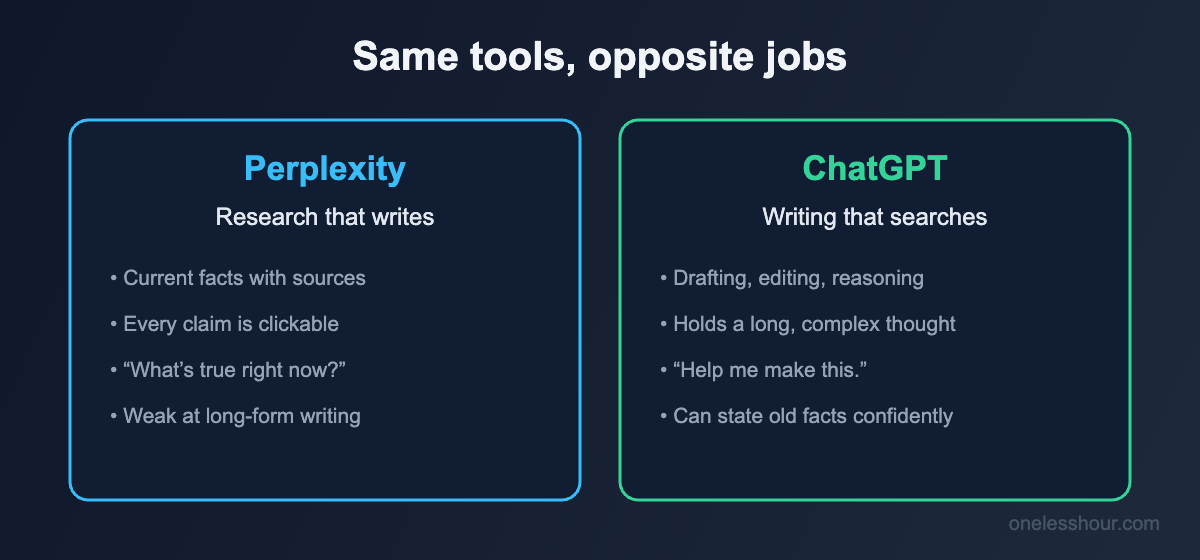
Perplexity is a research tool that writes. ChatGPT is a writing-and-thinking tool that can search. That distinction decides almost every “which should I use” question you’ll ever have.
When I need to know something that’s current and verifiable, Perplexity. When I need to make something, draft, brainstorm, reason through a mess, ChatGPT. Everything below is just detail on that.
How they compare on the stuff that matters
| Perplexity | ChatGPT | |
|---|---|---|
| Best at | Current facts with sources | Writing, reasoning, brainstorming |
| Citations | Every claim, clickable | Only when it searches, hit or miss |
| Feels like | A librarian who read everything today | A sharp colleague who thinks out loud |
| Free tier | Surprisingly useful, unlimited basic searches | Very capable, some limits on best model |
| Weak spot | Long creative or structured writing | Can state old or wrong facts confidently |
| Paid price | $20/month | $20/month |
I want to be upfront: I didn’t run a lab benchmark. This is two weeks of real work, a marketing plan, a house-buying research binge, a dozen blog drafts, and a lot of “wait, is that still true?” moments. Your mileage will shift with your job.
Where Perplexity wins for me
Anything where being wrong has a cost, I start with Perplexity. The reason is the little numbered citations after every sentence. I can click and see the source in one tap, which means I’m not trusting a confident paragraph, I’m checking it.
Real example: I was comparing two savings accounts and needed current rates. Perplexity pulled them with links to each bank’s own page. ChatGPT, on the same question, gave me a rate that turned out to be months old and had no source to check. That’s the whole difference in one screenshot.
Best for: current events, prices, stats, “what’s the latest on,” product research, medical or legal starting points you’ll verify anyway, anything where you need to cite where it came from. I lean on it constantly for the kind of digging I described in my guide to using Perplexity AI.
Pro tip: Turn on Perplexity’s “Focus” and point it at Academic or a specific source type when you want quality over quantity. It quietly filters out the SEO sludge.
Where ChatGPT wins for me
The second I need to build something, I switch. ChatGPT holds a longer thought, follows a persona, and reworks a draft ten times without losing the plot. Perplexity gets impatient with that; it wants to answer and move on.
When I fed both the same request, “turn these five messy bullet points into a warm client email,” ChatGPT’s version sounded like a person. Perplexity’s read like a summary of an email rather than the email itself. For tone, structure, and iteration, it isn’t close.
Best for: drafting, editing, brainstorming, coding, explaining a hard concept, working through a decision out loud, anything where you’ll go back and forth a few times. If you’re newer to it, my ChatGPT productivity guide covers the workflows I use most.
Pro tip: Give ChatGPT a role and constraints up front (“You’re a plain-spoken editor, keep it under 150 words”). It rewards specificity more than Perplexity does.
The workflow I actually use: both, in order
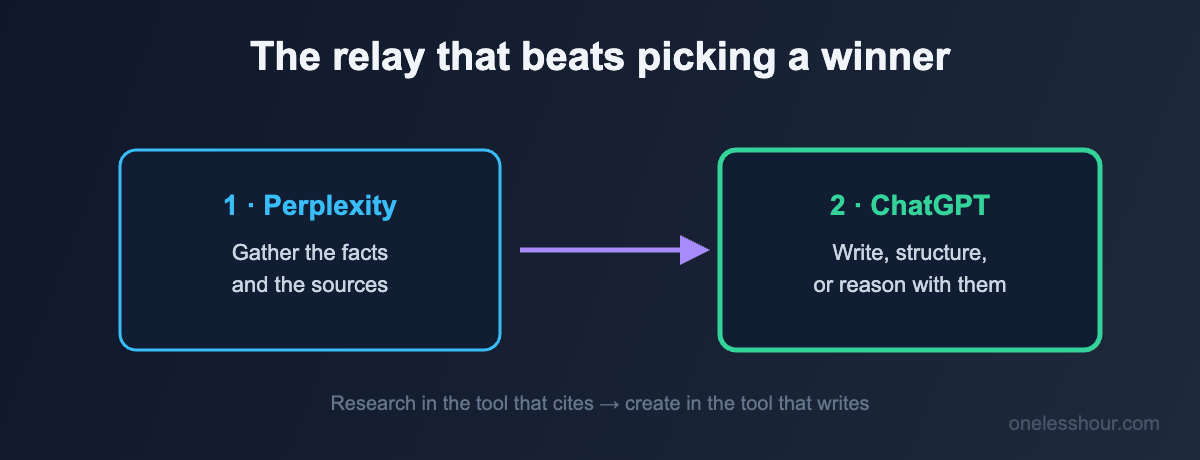
Here’s the part the “X vs Y” headlines miss. My best results come from running them as a relay, not picking a winner.
Step 1: Perplexity to gather the facts and sources. Step 2: paste those findings into ChatGPT and ask it to write, structure, or reason with them.
Research phase in the tool that cites, creation phase in the tool that writes. When I planned a two-week trip, I had Perplexity find current visa rules and neighborhood safety notes, then handed the lot to ChatGPT to build a day-by-day itinerary in the tone I wanted. Twenty minutes, start to finish. I break down that exact travel workflow more in my post on using ChatGPT for travel planning.
Try this now: Take one question you’d normally Google, run it in Perplexity for the facts, then paste the answer into ChatGPT and say “help me act on this.” That handoff is the whole trick.
Can you get away with just the free versions?
Mostly, yes, and this surprised me. Perplexity’s free tier is generous: you get unlimited standard searches with citations, which covers the core value entirely. You only hit limits on its deeper “Pro” searches, capped at a handful per day for free.
ChatGPT’s free tier is also strong now, with access to a capable model and limited use of the best one. For casual drafting and everyday questions, free is plenty.
Honest take: run both free for two weeks before paying either $20. Most people find one clearly earns the upgrade for their specific work and the other stays perfectly fine on free. Paying for both, like I do, only makes sense if you live in both daily. For more on which subscriptions are actually worth it, I keep a running list in my best AI tools for research roundup.
The honest downsides of each
Neither is magic. Here’s what annoys me about both after months of daily use.
Perplexity’s downside: it’s a weak writer. Ask for anything long, creative, or nuanced in tone and it gives you a competent summary with the personality of a manual. It also occasionally cites a low-quality source as if it were gospel, so the citations help but don’t excuse you from judgment.
ChatGPT’s downside: it will state something outdated or flatly wrong with total confidence and no source. On the free tier especially, it may not search the web, so “what’s the current price of X” can get you a made-up number. Skip it for time-sensitive facts unless you’ve explicitly turned search on and can verify.
Skip Perplexity if: your main need is writing, tone, and long-form output. Skip ChatGPT if: your main need is verifiable, up-to-the-minute facts with clickable sources. Most people need both jobs, which is exactly why the relay works. If you’re weighing other pairings too, I did a similar head-to-head in ChatGPT vs Claude.
Frequently asked questions
Is Perplexity better than ChatGPT?
For research with sources, yes. For writing, brainstorming, and reasoning, no. They’re built for different jobs, so “better” depends entirely on whether you’re gathering facts or creating something.
Do I need to pay for either one?
Not to start. Both free tiers cover the core experience. Run both free for a couple of weeks and you’ll quickly see which one your work leans on enough to justify the $20/month upgrade.
Does Perplexity use ChatGPT’s technology?
Perplexity runs on top of several large language models and lets paid users pick between them, including models from OpenAI and others. The difference isn’t the underlying model, it’s that Perplexity wraps it in live web search with citations by default.
Which is more accurate?
For current facts, Perplexity is more trustworthy because you can check every source it used. For reasoning through a complex problem, ChatGPT tends to go deeper. Accuracy depends on the task, and with either you should verify anything that matters.
Can I use both together?
That’s the best setup. Use Perplexity to research and gather sourced facts, then paste those into ChatGPT to write, structure, or plan. Research in one, create in the other.
My bottom line
Stop thinking of it as a fight. Perplexity answers “what’s true?” and ChatGPT answers “help me make this.” Pick based on which question you’re asking in the moment, and you’ll be right almost every time.
If you only try one thing from this, do the relay: research a real question in Perplexity today, then hand the sourced answer to ChatGPT and ask it to help you act on it. Do that once and you’ll stop asking which is better, because you’ll be using both for what they’re each great at.