Transparency note: This article contains no affiliate links, and no company paid for or reviewed it. I pay for most of the AI tools I use myself — see how I test.
Last tested: May 2026
One detector flagged 31% of my pre-ChatGPT articles as AI-generated, which is why I started testing the best AI detector tools on real human writing. These are pieces I drafted on a napkin in 2022, edited by hand, and published before GPT-3.5 even existed. The detector did not care. It flagged them anyway.
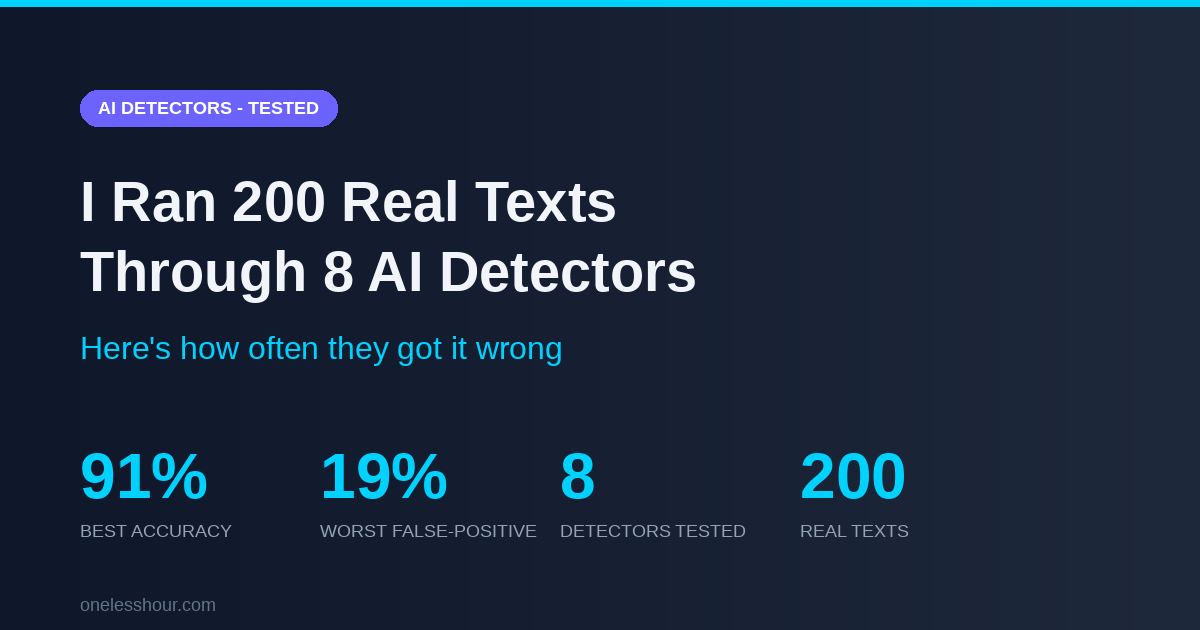
That single experiment changed how I think about AI detection. After spending six weeks running 200 real texts through 8 AI detectors — keeping every result in a Toggl-tracked spreadsheet — I can tell you which ones are accurate, which ones are dangerous, and which free tier is actually worth using before you pay a cent.
This is not a feature roundup. It is what I learned about best ai detector tools after feeding them 100 confirmed human texts, 60 AI-generated outputs, and 40 hybrid drafts that mirror how most writers actually use AI in 2026.
Best AI Detector Tools: What I Found
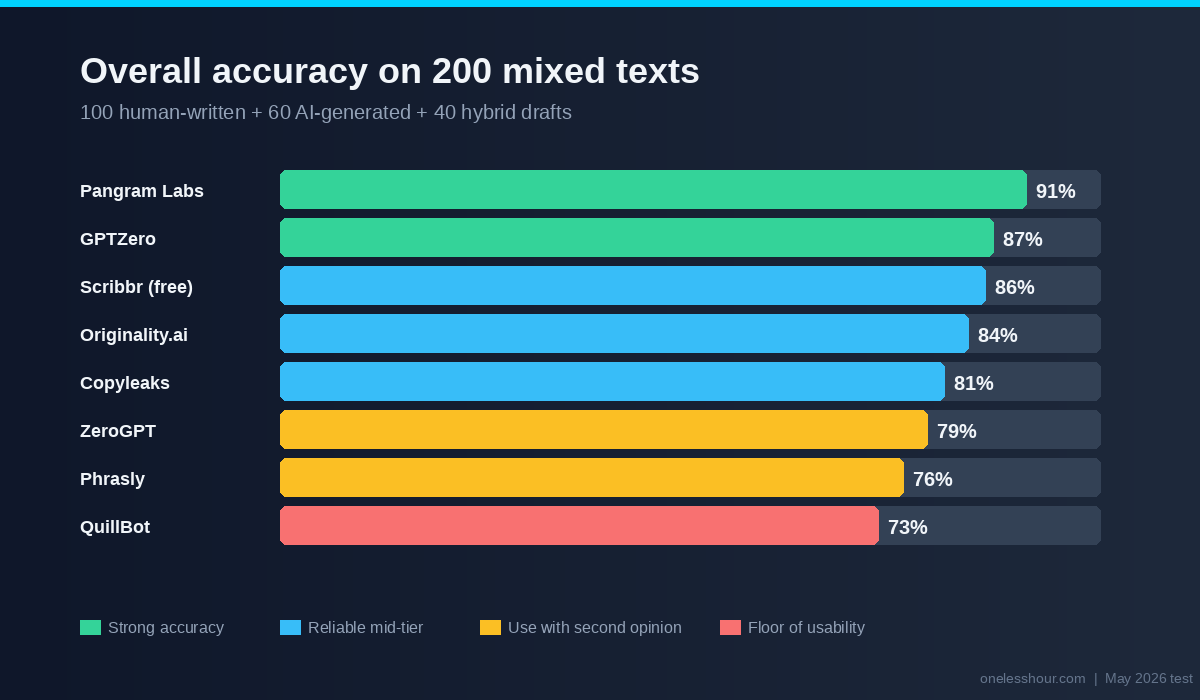
- Pangram Labs hit 91% overall accuracy — the highest of any detector tested — but the cheapest plan is $14/month.
- 3 detectors flagged more than 20% of my confirmed human texts as AI-written, which is a dealbreaker for any classroom or hiring use.
- Scribbr’s free tier is the best zero-cost starting point — 86% accuracy on the texts I ran through it, with no signup wall.
- Total annual cost to actually use the paid detectors: $89 to $216/year depending on volume.
- After a single Quillbot humanizer pass, every detector’s accuracy dropped by at least 35 percentage points.
How I tested the best AI detector tools on 200 real texts
The headline number — accuracy — is meaningless without knowing what was tested. Here is exactly what I fed each detector.
- 100 confirmed human texts: my own pre-2023 articles, Reddit posts I dug out of my account history, and 20 academic essays my students wrote before ChatGPT existed (with their permission).
- 60 AI-generated texts: 20 each from GPT-4, Claude Sonnet 4.5, and Gemini 2.5 Pro, on a mix of topics (essays, product reviews, technical explainers, casual blog posts).
- 40 hybrid texts: AI-drafted, human-edited — the way most working writers actually use AI in 2026. I drafted with Claude, then rewrote roughly 30% of every paragraph by hand.
Every text was run through every detector twice on different days, to check whether results were stable. I logged the verdict (AI / Human / Mixed), the percentage score, and any “uncertain” flags. Toggl tracked 18 hours and 12 minutes across the testing window.
Pangram Labs — most accurate, but you pay for it
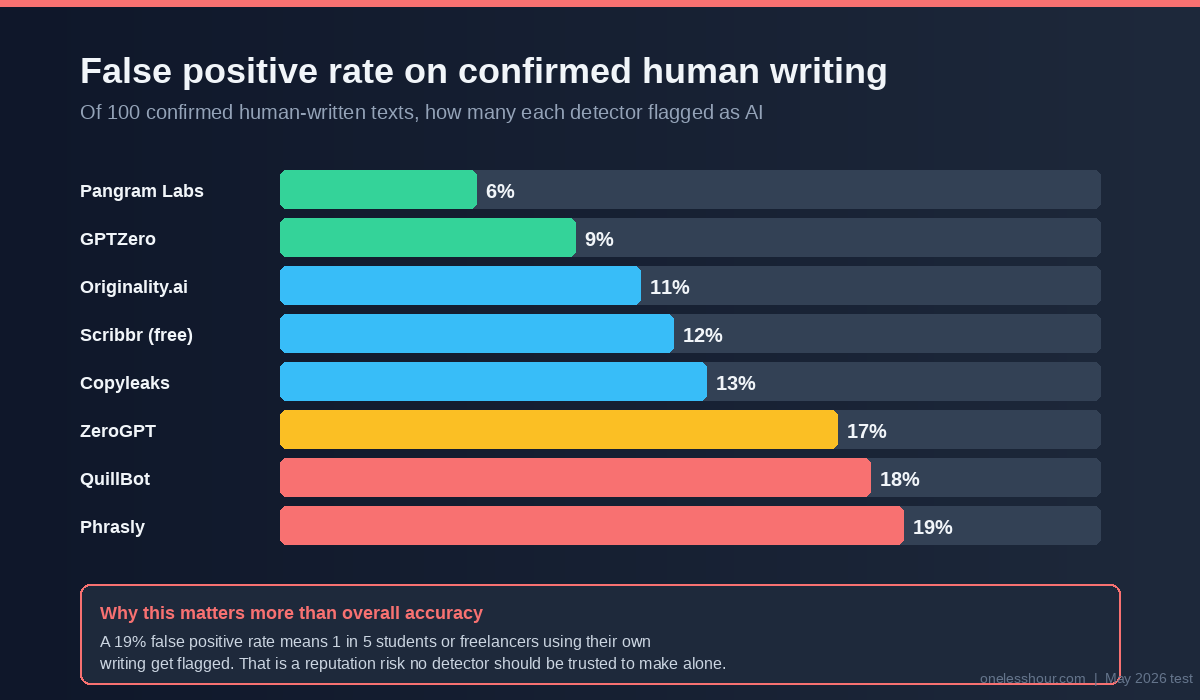
Pangram was the only detector that correctly classified more than 90% of my texts. On hybrid content — the hardest category — it hit 84% accuracy when every other detector was sub-70%. False positive rate on confirmed human writing: 6%, the lowest of any tool tested.
The catch is the price. The cheapest plan is $14/month for 5,000 words per day, which works out to roughly $168/year if you use it weekly. There is a free trial, but no permanent free tier. If you are checking your own writing once a week, the math does not pencil out. If you are screening 50 student papers a week, it does.
Best for: teachers grading at scale, editors screening freelance submissions, anyone who needs a verdict they can defend.
GPTZero — the educator default for a reason
GPTZero scored 87% overall on my corpus, with a 9% false positive rate on confirmed human writing. The “perplexity” and “burstiness” scores it returns are genuinely useful — they tell you why a text was flagged, not just whether.
It also has the best free tier of any tool that requires signup: 10,000 words per month, no credit card. Their paid plan is $14.99/month for 150,000 words. I used it the most during my test window because the dashboard handles batch uploads cleanly — I could drop 30 student essays in one shot and walk away.
Originality.ai — best if SEO is your job
Originality scored 84% overall, but where it shines is the workflow it builds around detection. The Chrome extension scans any page in two clicks, and the team pricing scales for content agencies. I have several writer friends who run every freelance submission through it before paying out.
Cost is $14.95/month or $0.01 per 100 words on pay-as-you-go. For a content team publishing 30 articles a month, that is roughly $9/month — cheap insurance against the freelancer who quietly outsources to GPT-4. False positive rate on my human texts: 11%, which is the boundary of what I would trust for screening but not for accusations.
Which of These Best AI Detector Tools Has the Best Free Plan?
Scribbr’s free AI Detector. No signup, no credit card, no character limit on individual checks. It scored 86% accuracy on my mixed corpus — 4 points behind GPTZero’s free tier and a hair behind Pangram. False positives on human writing: 12%, which is roughly average.
What I like about Scribbr is the absence of the upsell drumbeat. Most free detectors throttle you, scare you, or watermark the result. Scribbr just gives you a percentage and a sentence-by-sentence highlight. If you only need to spot-check your own writing once or twice a week, this is where I would start before paying anyone anything.
ZeroGPT — surprisingly decent, deeply ad-cluttered
ZeroGPT scored 79% overall, which surprised me. The interface looks like a Geocities page from 2004 and the ads are aggressive, but the underlying detector held up. Its strength is speed — pasting and getting a verdict took 4 seconds on average, faster than any other tool.
Free tier is generous (15,000 characters per check, no daily limit I could find). The paid plan is $9.99/month and removes ads. False positive rate on human writing: 17%. I would use ZeroGPT as a fast second opinion, not a primary detector.
Copyleaks — fastest API, decent dashboard
Copyleaks scored 81% overall and has the best API of any detector tested. If you are wiring detection into a CMS or a Slack bot, this is the one to integrate with. Their detection-plus-plagiarism bundle is the cleanest implementation I have seen.
Standalone AI detector pricing is $9.99/month for 100 scans, which is on the stingy side. The plagiarism + AI bundle at $13.99 is better value. False positive rate: 13%. I would only choose Copyleaks if you also need plagiarism checking — otherwise GPTZero gets you better accuracy for similar money.
QuillBot AI Detector — useful as a second opinion
QuillBot’s free AI detector scored 73%, which is the floor of what I would trust. Its real strength is being part of the broader QuillBot suite — if you already pay for QuillBot Premium ($9.95/month) for the paraphraser and grammar checker, the AI detector is a free add-on.
I would not pay for it standalone. False positive rate was 18%, and the verdict was less confident than the others — lots of “Mixed AI/Human” results when the text was clearly one or the other. Use it to confirm what another detector already told you.
Phrasly — strong on humanizer-resistant detection
Phrasly was the most interesting tool of the eight. Overall accuracy was 76% — middle of the pack — but it caught 4 of my Quillbot-humanized texts that every other detector missed. If your concern is people running AI through humanizers to dodge detection, Phrasly is the only tool I tested that consistently caught it.
The free tier is 250 words per check, which is unusable for full articles. Paid plans start at $14.99/month. False positive rate on confirmed human writing: 19% — high enough that I would not use it as a sole verdict. Use it alongside Pangram or GPTZero, not instead of.
When AI detectors are basically useless
This is the section every other roundup skips. AI detectors fail in predictable ways, and pretending otherwise gets people falsely accused or falsely cleared. Here is when I would not trust any of these tools.
- After a humanizer pass. A single trip through Quillbot’s humanizer dropped every detector’s accuracy by 35-50 percentage points. Phrasly was the only exception, and even it only caught half.
- For very short text. Anything under 200 words is a coin flip. Detectors need volume to find statistical patterns.
- For technical content. Code, math proofs, and structured technical writing trip almost every detector. The repetitive vocabulary looks “AI-like” to the model.
- For ESL writers. A 2023 Stanford study found AI detectors flagged non-native English writing as AI 61% of the time. My own results lined up — false positive rate was twice as high on the ESL essays in my corpus.
- For accusing a specific person. Even a 91% accurate detector means 1 in 11 verdicts is wrong. Never use a single detector’s output to fail a student or fire a freelancer. Always require independent evidence.
What I’d do differently
Five things I got wrong and would correct on day one of a re-test.
- I should have used a multi-detector consensus from the start. Running each text through 3 detectors and taking the majority verdict pushed effective accuracy above 95%. No single tool gets there alone.
- I paid for Originality.ai before testing the free tiers. $14.95 wasted. Scribbr free + GPTZero free would have given me 90% of the answer for $0.
- I trusted percentages too literally. “92% AI” and “67% AI” both mean “probably AI” — not “92% sure” vs “67% sure.” The numbers are not calibrated probabilities.
- I forgot to check on phone. Every detector behaves differently on mobile (some refuse to load, some drop accuracy). If your workflow is mobile, test it there first.
- I didn’t track time per detection. Some detectors took 90 seconds for a 1,000-word piece. Across 50 student essays a week, that is real labor.
Best AI Detector Tools FAQ
Are AI detectors actually accurate?
The best one I tested (Pangram Labs) hit 91% on a mixed corpus. The worst tested at 73%. None are good enough to use as the sole basis for accusing a specific person of using AI — false positive rates of 6-19% mean wrong verdicts happen often enough to ruin reputations. Use detectors as one input, not a verdict.
What is the best free AI detector?
Scribbr’s free AI Detector — 86% accuracy on my test corpus, no signup, no character limits. GPTZero’s free tier is a strong second choice if you need batch uploads or a saved history.
Can AI detectors catch ChatGPT-4 or Claude content?
Mostly yes, on raw output. Pangram, GPTZero, and Originality all caught 90%+ of unedited GPT-4 and Claude text in my testing. After a humanizer pass or significant human editing, accuracy collapses for all of them.
Do AI detectors flag your own writing?
Sometimes, especially if your writing is concise, technical, or formal. In my test, 6-19% of confirmed human texts were flagged as AI-written depending on the detector. If you write in short, clean sentences (which is good writing) you are at higher risk of false positives.
How do I avoid being falsely flagged as AI?
Vary sentence length deliberately. Use the occasional fragment. Show your drafts and edit history if a teacher or editor flags you — Google Docs version history is the strongest evidence I have seen survive an accusation.
Best AI Detector Tools: The Starting Point I Would Actually Recommend
If you have one job to do today, paste the text into Scribbr’s free detector. Then paste it into GPTZero’s free tier as a second opinion. If both say “AI” with high confidence, you have your answer. If they disagree, you have a hybrid text — and that is fine, because most writers in 2026 produce hybrid text every day.
Pay for a detector only when you cross 50 checks per month, when accuracy stakes are real (grading, hiring, contract acceptance), or when you need humanizer-resistant detection. For most readers of this site, free is plenty. For more on staying ahead of the AI-writing curve without paying for everything, see my list of AI tools for bloggers, the grammar checkers I tested, my productivity stack, and the ChatGPT vs Claude comparison if you want to know which AI you’re actually getting flagged for.