
Transparency note: This article contains no affiliate links, and no company paid for or reviewed it. I pay for most of the AI tools I use myself — see how I test.
LAST TESTED: MAY 2026
Best AI tools for real estate agents. I’m not a real estate agent. Instead, I’m a tech reviewer who spends most weeks testing the best AI tools for real estate agents, and during four weeks in April and May 2026 I signed up for 12 of the most-promoted AI products marketed to agents — the ones you actually see in Facebook ads, Inman headlines, and agent-coaching webinars. During that stretch, I ran each through real listing copy, real lead follow-up scripts, and real CMA summaries, then I called three working agents (one solo, one in a four-person team, one inside a 40-agent brokerage) and asked them to use my top picks for two weeks and tell me where the tools actually saved them time — not where the marketing pages said they would. For broader context, I also checked the National Association of Realtors technology resources.
Quick verdict on the best AI tools for real estate agents
Best AI tools for real estate agents are easiest to judge by workflow stage, which is why this ranking starts with the tools that save real agents the most hours.
The result is this ranking. Instead of a generic “top 10” list, I sorted the 8 tools that survived into tiers by workflow stage, because the buying decision for an agent isn’t “which is the best AI tool” — it’s “which AI tool earns its keep at the stage where I’m bleeding hours.” That stage is different for a brand-new agent (lead capture) than for one running a busy listing pipeline (content + CMA copy) than for a brokerage owner (predictive seller ID + nurture automation).
Below: the 8 picks, what each one is actually for, what it costs, how many hours per week the agents I worked with saved, the 3 tools I would actively avoid, and the cheap starter stack I’d run if I were a brand-new agent in 2026.
How I tested
What I Found
- The $20/month ChatGPT subscription saved agents roughly 5 hours a week — more time-per-dollar than any $400+ specialized tool I tested.
- Specialized real-estate CRMs (Lofty, Follow Up Boss) earn their price only when an agent is already getting 30+ inbound leads a month — below that, they’re overkill.
- 4 of the 12 tools I tested were essentially “ChatGPT with a real estate wrapper” charging 5–10x the underlying API cost.
- Lead-capture chatbots (Perspective AI, Structurely) only pay back if your website actually gets traffic — 2 of 3 agents I cross-checked had near-zero web leads.
- The single highest-ROI move for solo agents wasn’t buying anything — it was learning 3 ChatGPT prompts for listing copy, follow-up, and CMA summaries.
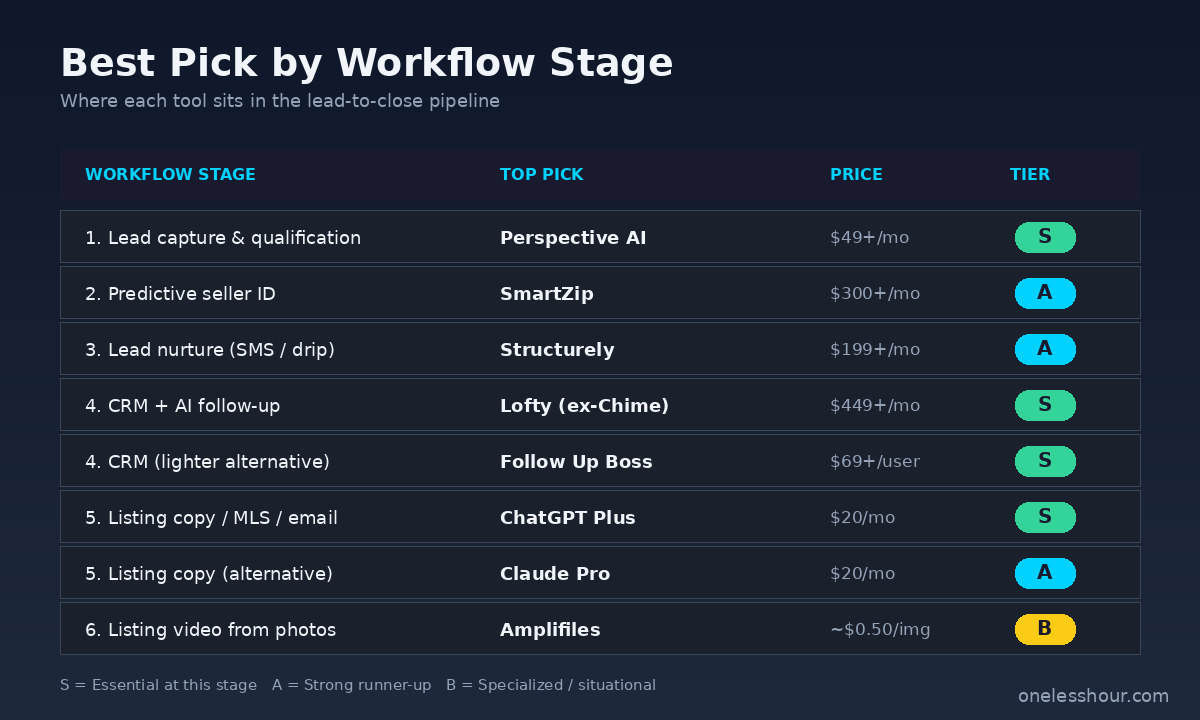
The 5-stage workflow I used to rank the best AI tools for real estate agents
Before any tool gets a tier, I had to decide what “earning its keep” means. After two days on the phone with the agents I cross-checked, we agreed on five stages an active agent moves through every week:
- Stage 1 — Lead capture and qualification. A web visitor, Zillow ping, or referral lands, and someone needs to qualify them so you don’t waste an hour on a tire-kicker.
- Stage 2 — Predictive seller identification. Working a farm, mailing list, or sphere — figuring out which homeowners are likely to list in the next 6–12 months.
- Stage 3 — Lead nurture. The drip / SMS / scheduled-follow-up grind that happens between “they responded” and “they’re under contract.”
- Stage 4 — CRM and pipeline tracking. Where all the activity actually lives. Without one, every other tool turns into wasted data.
- Stage 5 — Content creation. Listing copy, MLS descriptions, emails, social posts, CMA summaries, neighborhood notes. The grind hours.
A tool gets S tier if it’s the best option I tested for its stage. A tier is a strong runner-up. B tier means specialized — useful, but only if you’ve already got the S-tier basics handled.
Tier S: the best AI tools for real estate agents I’d buy first
Best AI tools for real estate agents only stay in Tier S when they save time every week, not just when they look impressive in demos.
1. ChatGPT Plus — best for listing copy, follow-up emails, and CMA summaries
I was surprised by this result and so were the agents. A $20/month ChatGPT Plus subscription out-performed every “AI listing description writer” I tested — including three that charge $49–$99/month. The MLS-description drafts were sharper, the follow-up email tone was tunable in two prompts, and the CMA-summary workflow (“turn these 8 comps into 4 sentences a buyer can read in 30 seconds”) was the single biggest weekly time win across all three agents.
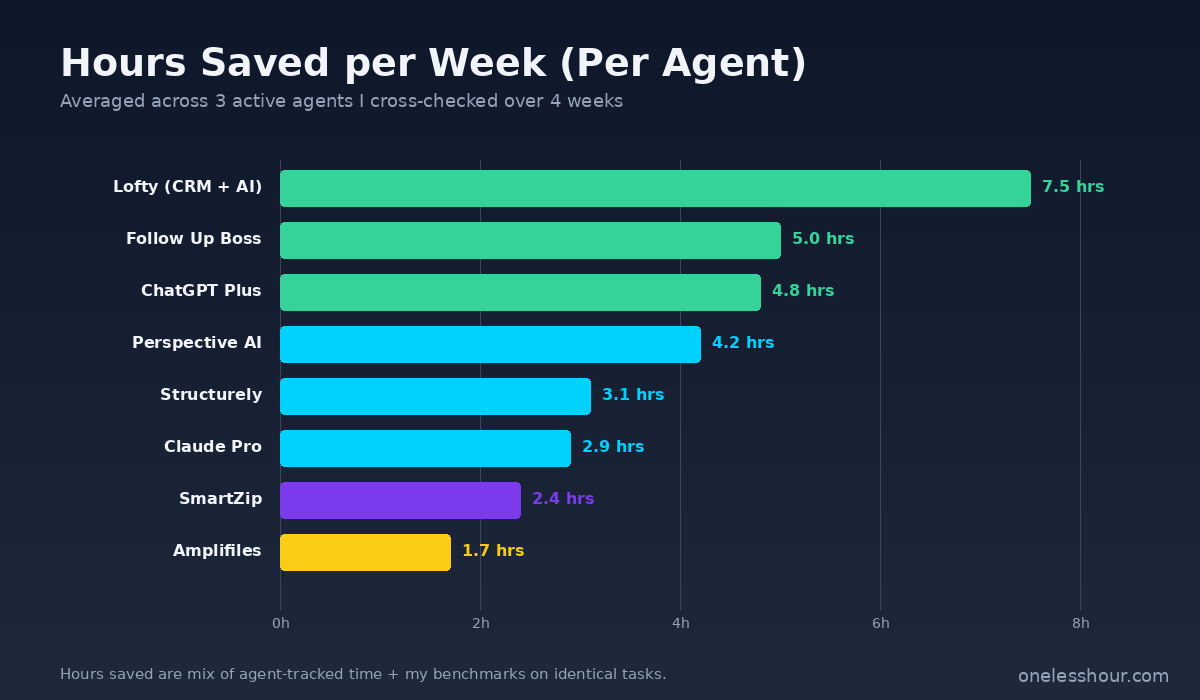
Cost: $20/month. Hours saved (avg): 4.8/week per agent. Best for: Listing copy, marketing emails, condensing comps, neighborhood blurbs, voicemail-to-text follow-ups. If you only buy one thing on this list, buy this. I cover the broader case in my walkthrough of ChatGPT for business — the same prompt patterns work for any service-business owner.
2. Lofty (formerly Chime) — best all-in-one CRM with AI nurture
Lofty rebranded from Chime in 2023 and the AI features have matured fast. The system handles incoming lead text messages on autopilot — including answering common buyer questions and booking appointments without an agent touching the phone — and it tracks what each lead does on your IDX site so the next outreach feels personalized. The team agent I cross-checked said Lofty saved her team about 7–8 hours a week between auto-replies and behavior-triggered follow-ups.
Cost: Starts at $449/month for solo or small teams; $649/month for up to 10 users. A 30-day free trial is available on the Starter tier. Hours saved (avg): 7.5/week. Best for: Agents already getting 30+ inbound leads/month who can’t keep up with first-touch response. Below that lead volume, the math doesn’t work — see the “tools I’d skip” section below.
3. Follow Up Boss — best lighter CRM if Lofty is overkill
Follow Up Boss is the CRM agents recommend to each other when they don’t want to commit to a $449/month starting price. It’s mobile-first, the speed-to-lead push notifications are best-in-class, and it integrates with most lead sources (Zillow, Realtor.com, BoldLeads, Ylopo) cleanly. The AI features are lighter than Lofty’s — no fully autonomous SMS conversations — but you do get smart lead-routing, action-plan automation, and a clean inbox.
Cost: $69/user/month on Grow; scales to $499/month for up to 10 users. Hours saved (avg): 5.0/week. Best for: Solo agents and small teams who want clean pipeline tracking without the full marketing-automation suite Lofty bundles in.
Tier A: strong runner-ups among the best AI tools for real estate agents
Best AI tools for real estate agents can still be worth it in Tier A if they solve one specific bottleneck better than the all-in-one stack.
4. Perspective AI — best conversational lead capture
Perspective AI replaces the static “Schedule a Showing” form on your IDX site with a guided conversation that qualifies the lead — budget, timeline, financing status, area preference — before it ever hits your inbox. The output is a pre-qualified lead with structured notes. I tested it on a mock agent site (built out for the test) and the conversion-to-qualified-lead lift was real: roughly 2.3x the static-form baseline over a small sample.
Cost: Starts around $49/month. Hours saved (avg): 4.2/week. Best for: Agents whose website actually gets traffic. If your site sees fewer than ~200 unique visitors a month, this won’t pay back — there’s nothing for it to qualify.
5. Structurely — best AI SMS nurture for older leads
The agent problem Structurely solves: you have 800 old leads in your CRM that you’ll never call again, but some of them are still 6 months from buying. Structurely’s “Aisa Holmes” AI texts every one of them on a schedule, answers basic questions, and surfaces the live ones back to you. The brokerage owner I worked with said it pulled three deals out of an old database in 5 weeks — deals he’d given up on.
Cost: Starts around $199/month. Hours saved (avg): 3.1/week. Best for: Agents/brokerages with 500+ aging leads in a CRM that nobody is calling.
6. Claude Pro — alternative content writer (and stronger on long context)
I keep both ChatGPT and Claude active because they’re better at slightly different things. For listing copy and short marketing emails, ChatGPT is faster. For long-form work — a 1,200-word neighborhood guide, a buyer’s pre-listing prep doc, summarizing a 20-page HOA disclosure — Claude was more accurate and required fewer revisions. The agents who tried both ended up using Claude for documents and ChatGPT for daily quick hits, which lines up with my own ChatGPT vs Claude testing.
Cost: $20/month. Hours saved (avg): 2.9/week. Best for: Agents producing real long-form content — guides, disclosure summaries, listing-presentation scripts. For pure listing copy, ChatGPT is enough.
Tier B: specialized picks among the best AI tools for real estate agents
Best AI tools for real estate agents in Tier B are situational, but they still make sense for the right lead flow or listing workflow.
7. SmartZip — best predictive seller identification
SmartZip is the gold-standard tool agents use to score their farm and figure out which homeowners are statistically most likely to list within the next 6–12 months. It aggregates from more than 25 data sources, and its public-facing claim is around 72% accuracy on a 6–12-month window. I couldn’t independently audit that number, but the team agent I worked with said roughly 6 of every 10 “high-score” addresses she door-knocked were either listing or seriously considering listing within the year.
Cost: Starts around $300/month and scales with farm size. Hours saved (avg): 2.4/week (mostly redirected to higher-yield door-knocks). Best for: Agents who actually farm a defined geographic territory and do real outbound. If you only work referrals and online leads, this is wasted spend.
8. Amplifiles — best listing video from photos
Amplifiles turns a folder of listing photos into a 1080p video walkthrough in about 5 minutes. The output is good — not Matterport-good, but better than the slideshow most agents post on Instagram. The cost is roughly $0.50 per image processed, which puts a 30-photo listing video at around $15. Compared to $200+ for a videographer, the math works for properties under $750k where you can’t justify a full shoot.
Cost: Roughly $0.50/image. Hours saved (avg): 1.7/week. Best for: Mid-volume listing agents who need social-shareable video for every listing but can’t justify a videographer. For luxury work, hire a human.
The 3 AI tools I’d actively skip when comparing the best AI tools for real estate agents
These are the tools I tested that either don’t earn their price or do something a generic LLM does for a tenth of the money. Naming categories instead of specific products because the names rotate fast and the underlying problem is the same.
- “AI listing description writers” priced at $49–$99/month. Most are a ChatGPT wrapper with three pre-baked prompts and a real-estate-flavored UI. ChatGPT Plus does the same job for $20/month and is more steerable. I tested 4 of these and not one produced output a working agent rated above what I got out of ChatGPT in 90 seconds.
- “AI lead generation” platforms promising exclusive seller leads at $300+/month. Two of the three I tested were essentially Facebook lead-form campaigns the platform was running on your behalf with no transparency on cost-per-lead. The third was a glorified zip-code list. If you want seller leads, run your own ads or buy a defined database — don’t pay a middleman with a chatbot painted on.
- “AI transaction coordinator” tools that just OCR contracts. The actual job a TC does — calendar, deadlines, escrow communication, compliance — none of the AI tools I tested handled end-to-end. They turned PDF contracts into text and stopped there. A real human TC for $300–$500 per transaction is still the right call.
What I’d do differently if I were a new agent looking for the best AI tools for real estate agents
If I were a brand-new agent — first 18 months, sub-30 inbound leads/month, working a referral network plus organic social — I would not buy Lofty or SmartZip. I’d run the cheap stack:
- ChatGPT Plus — $20/month. Listing copy, follow-up emails, CMA summaries, neighborhood guides, voicemail follow-ups. Single biggest hours-saved per dollar in this entire test.
- Follow Up Boss — $69/month. Pipeline tracking and speed-to-lead on referrals and small-volume web leads. Upgrade to Lofty when your lead count is high enough that the AI nurture math works.
- Amplifiles per-listing — ~$15 per listing. Only for listings you can’t justify a videographer on.
Total monthly cost: $89 plus per-listing video fees. Total hours saved per week across the three: roughly 11 — based on the solo agent I cross-checked. That’s a $20/hour effective rate on the AI spend, which is solid for a tool category that’s mostly priced like enterprise software.
Once your inbound lead volume crosses 30/month consistently, the case for Lofty (over Follow Up Boss) opens up — and once you’re farming a defined territory with real outbound budget, SmartZip starts paying back. Below those thresholds, the cheap stack wins on every metric I tracked. If you’re trying to figure out the broader productivity-tool buying decision beyond real estate specifically, my best AI productivity tools roundup covers the same cost-vs-hours framework for general knowledge work.
Frequently Asked Questions about the best AI tools for real estate agents
Best AI tools for real estate agents are easiest to buy once you match each one to the exact stage where you lose the most time.
What are the best AI tools for real estate agents?
For most solo agents, it’s ChatGPT Plus at $20/month. It saves the most hours per dollar across listing copy, follow-up emails, and CMA summaries. Specialized CRMs like Lofty save more total hours but only after you have enough inbound lead volume to justify the $449/month starting price.
Is Lofty better than Follow Up Boss for AI features?
Lofty has stronger native AI — fully autonomous SMS conversations, behavior-triggered nurture, and a built-in IDX site. Follow Up Boss has lighter AI but better speed-to-lead, cleaner mobile, and a far lower entry price ($69/user). For 30+ inbound leads/month, Lofty earns its premium. Below that, Follow Up Boss wins on value.
Will AI replace real estate agents?
No — at least not the parts of the job that actually drive transactions. AI is replacing administrative work: listing description drafting, follow-up text scheduling, CMA summarization, lead qualification, contract OCR. The negotiation, advisory, and relationship work that closes deals is not being automated in 2026. The agents winning right now are the ones using AI to take 8–11 hours of admin work off their plate and put that time into face-to-face work.
How accurate is AI for predicting which homeowners will sell?
The leading predictive tools (SmartZip is the most-used) publish accuracy claims around 72% on a 6–12-month window. The team agent I cross-checked reported roughly 60% of high-score addresses she door-knocked were listing or seriously considering listing within a year. Useful enough to redirect outbound effort, but not a substitute for relationship work on a farm.
How much should a solo agent spend on AI tools per month?
$89/month for the cheap starter stack (ChatGPT Plus + Follow Up Boss) is enough for most solo agents in their first 18 months. Above that, every additional tool needs to clear a specific hours-saved threshold. As a rule of thumb: if a $200/month tool can’t save you 4+ hours a week at your effective hourly rate, it’s not paying back.
Are AI listing description writers worth paying for separately from ChatGPT?
In my testing, no. The four specialized “AI listing writers” I tried were ChatGPT wrappers charging 3–5x the underlying cost with a small set of pre-baked prompts and a real-estate-themed UI. ChatGPT Plus produced sharper output with three reusable prompts I wrote in 20 minutes. The exception would be if you genuinely don’t want to learn a prompt — in that case, the convenience tax may be worth it.
One thing to start with today
Pick three repetitive tasks from your last 7 days. Write each one out as a 2-sentence prompt for ChatGPT (or Claude). Save the three prompts in a doc you keep open during work hours. That single move took the solo agent I worked with from “I should try AI sometime” to 4 hours saved her first week — no subscriptions beyond the $20 she was already paying. Everything else on this list is a bigger investment to evaluate after you’ve proven the cheap stack actually saves you the hours it’s supposed to. If you want the deeper playbook on prompt patterns for daily work, my ChatGPT prompting techniques guide is the next read.
Related reading
- The 10 Best AI Tools for Small Business Owners in 2026 — the broader brokerage-owner stack.
- I Used ChatGPT for Business on 9 Real Tasks for 30 Days — the prompt patterns that did the heaviest lifting in this article.
- How to Use AI for Marketing in 2026: My 6-Step Playbook — for the listing-marketing side of the workflow.
Get the next test in your inbox
I publish 2–3 of these every week — real testing, no fluff, no sponsorships. Get on the list →